Pink cocaine: Why the name tells you nothing about what's inside
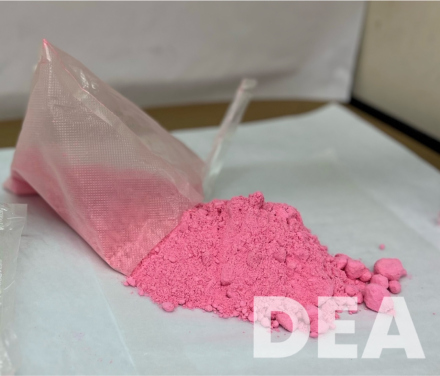
Photo: US Drug Enforcement Administration (DEA), public domain. Original source.
Pink cocaine sounds like a specific drug. It isn’t. Also known as tusi or tucibí, it is a street name for pink-coloured mixtures whose ingredients can vary from batch to batch. The US Drug Enforcement Administration (DEA) has documented very different combinations sold under the same label. The colour cannot tell you what is inside.
New laboratory evidence reinforces that point. A November 2026 forensic paper on six tusi samples seized in Italy found ketamine and MDMA in all six, 2C-B in two and no cocaine. A separate Miami-Dade study found another mix, including cocaine in some samples. Neither small study describes the entire market. Together, they show why the name is misleading.
What the latest lab tests found
A paper published online on 11 November 2026 in Forensic Science International examined six pink powders collected during four police seizures in Italy between February 2024 and July 2025. The team, led by Francesca Vernich, found ketamine and MDMA in all six, caffeine in five, and 2C-B in two. Cocaine was absent from all six.
The quantities were not consistent either. Ketamine ranged from 11.0% to 56.3% of the tested material, while MDMA ranged from 2.8% to 27.3%. That is an extraordinary difference between powders sold under the same name. The study is small, and six seized samples are not a survey of everything sold in Italy. What they do show is that even a shared label and colour tell you remarkably little about the mix or its strength.
There is one important correction to a popular claim here: tusi does not never contain 2C-B. In this Italian set, two samples did. It is simply not an ingredient you can assume is present. The new Italian forensic paper adds evidence to a picture that is more complicated than the slogan.
Same name. Different ingredients.
In a 2025 Miami-Dade medical examiner case series, investigators analysed 14 powder samples recovered from eight death investigations spanning 2020 to 2024. All 14 contained ketamine. None contained 2C-B. But five did contain cocaine.
No fentanyl was detected in those 14 powders. That matters, because a different sample set should not be made to carry a headline it cannot support. The Miami samples were collected in the context of death investigations, not through random testing of street supply, and the number is too small to produce a reliable prevalence estimate. Nor should the eight investigations be described as eight confirmed overdose deaths.
The comparison is still revealing: in one set, 2C-B appeared and cocaine did not. In the other, cocaine appeared and 2C-B did not. The same name covered different chemistry.
Why call it tusi at all?
Tusi, tucibí and tusibí developed from the Spanish-language pronunciation of 2C-B. Originally the name pointed to a specific psychedelic. Over time, the street label detached from that substance and became associated with coloured mixtures, often involving ketamine and MDMA. The European Union Drugs Agency and the US Drug Enforcement Administration both describe that shift.
It is the drug-market equivalent of a brand name surviving while the recipe changes. Pink dye makes the product recognisable; it does not identify an active ingredient, a dose or a level of purity.
The risks are in the mixture, not the colour
The DEA has documented a range of combinations marketed as pink cocaine, from ketamine with MDMA to separate mixtures involving methamphetamine, cocaine, fentanyl or xylazine. Those are documented possibilities, not a claim that every pink powder contains opioids. Equally, the Miami finding of no fentanyl cannot establish that all tusi is fentanyl-free.
In a club or at a festival, that uncertainty changes the risk. Ketamine combined with alcohol or other depressants can intensify sedation and impair breathing or awareness. Stimulants and depressants can also mask one another’s effects, making a mixed substance harder to judge by how it initially feels.
If someone chooses to use a substance, avoiding combinations, staying with trusted friends and accessing a professional drug-checking service where available are practical harm-reduction steps. In the UK, The Loop offers drug checking in selected settings and WEDINOS provides a testing service. Testing can identify substances, but no result makes drug use risk-free. If someone becomes unresponsive or has trouble breathing, call emergency services immediately.
The takeaway
The question is not whether pink cocaine is always cocaine, 2C-B or something else. The evidence shows it can contain some of those substances, neither of them, or a changing combination of other drugs. The name is not a test result. The DEA guidance and the two laboratory studies point to the same conclusion: every batch is an unknown until it is tested, and testing does not guarantee safety.
Sources

More in News
All of it News
Mochakk’s New 90-Minute VERMELHA Set Is Now Online via BOMA Records
20 Nov 2026/2 min read News
Marco Carola, Amnesia and the €2.4M Ibiza Club Dispute
19 Nov 2026/2 min read News
Unreleased house IDs are turning up in GTA VI
CircoLoco Records Radio is the club station on the Leonida dial, and the people playing the game are identifying records that do not exist yet. Fifteen unreleased IDs so far, from Chris Stussy to Seth Troxler, sitting next to catalogue that has been out for years.
19 Nov 2026/4 min read